Tuesday, September 20, 2016

visiting the villages of Essequibo


the docks of Parika

A fellow Guyanese lawyer generously gave me an opportunity to accompany her while she left the capital city of Georgetown to work in Region 2, the Pomeroon-Supenaam area along the Essequibo coast.


My day started before 6AM in the picturesque village of Eccles, which is on the outskirts of Georgetown in a neighbourhood that had the idyllic neighbourly feel of a North American subdivision.


We then set off in her pickup truck on the long journey through Region 3 district of Essequibo Islands-West Demerara, on the bridge over the Demerara River with its clanking metal plates and through the many villages along the way.

Demerara Bridge

Demerara River


Eventually we arrived in the township of Parika. Even though my colleague described it as an outpost that was too small to be a town, it was impressively busy with dozens and dozens of vendor stalls along the roads selling pretty much anything you might need - fruit, DVDs, plaintain chips, clothes, hammocks, and cold drinks. It's known for its Sunday markets, but even on a Wednesday it was bustling, due to the fact that it is a port hub for both land and river transportation.

bringing in the fruit

We ourselves were there to take a water taxi through the Essequibo Islands. We were allowed to park at the Parika Police Station (I imagine because of my colleague's good relations with the police and not because the Parika police let city folks use their lot for free parking) and did a little bit of shopping at the market stalls. Sadly there was no honey available, which this area is well known for, because of production problems due to the weather, but it was nice to be greeted by a number of locals on the street who all seemed to know my colleague.  It was a refreshing breath of fresh air to be away from hectic Georgetown in this friendly port, where robbery rates are much lower and nobody was catcalling me (but again, maybe it was thanks to my respected colleague accompanying me).


slogan on the side of one of the water taxis - pretty good life motto!
Eventually, we made our way to the water taxis and loaded into the boat. Usually you have to wait until the boat is full before they leave, and sometimes that can be a very long time if there aren't a lot of folks looking to cross the river, but luckily at this time of day (about 7:30AM, I think?), there were many commuters taking the trip, so we were able to take off shortly.  Some folks were with their kids, some businessmen had their briefcases, and I saw one man stepping off the dock with two crates filled with live chirping yellow chicks.


It was a lovely boat ride through the Essequibo Islands. The local Guyanese refer to the water taxis as as speed boats, but my colleague explained that they aren't really speed boats in the sense of some of the monstrous roaring ego machines you see at cottages on the lakes of North America, but they are boats with motors and we were still zipping through the water at a fun pace.

There are over three hundred islands on the Essequibo river, some uninhabited and some inhabited with even farms. This region reminded me somewhat of the Thousand Islands in the St Lawrence River in Ontario. There were so many huge islands everywhere! The scenery was absolutely breathtaking.  Despite the fast clip of the boat, I felt myself relaxing into a peaceful tranquility.


Court is sometimes held in the communities on the islands too, and the lawyers and magistrates travel to the various communities in the region, much like the circuit courts held in community halls and high school gyms in Nunavut.  They may not have to deal with propellor plane issues
due to cold weather conditions like Arctic lawyers do, but transport in these parts of Guyana is not always easy. My colleague explained to me that once after court had ended, there were no more water taxis and she had to find her own way back. She waited and waited until a farmer offered to let her hitch a ride on his boat - as long as she was okay with sharing the ride with his herd of goats and sheep. What else could you do? So she got on the boat, wearing her suit and carrying her briefcase. Luckily, the sheep and goats were used to the boat ride and sat calmly through the boat ride.

(For a somewhat similar story about the adventures of lawyers trying to make their way home from remote regions, read Senator Dennis Paterson's account of being a legal aid lawyer in Nunavut/Northwest Territories in the early days, quoted in an article that I wrote for the Polar Barrister - page 8!) 


Although enjoyable, the boat ride took longer than I initially thought it would, because the Essequibo River is much wider than I thought it would be. Once we got off the docks, we stopped off at a snack stand, where I got an aloe juice (as an Asian, I'm thrilled to report they sell these everywhere!) and a delicious snack made from cassava, which is a root and is also apparently listed as one of the world's most dangerous foods because if you do it wrong it can produce cyanide. But it was soooo yummy. Maybe the danger makes it delicious.

Welcome to the Pomeroon-Supenaam Region
snack stand full of tasty goodies

Then, as if our journey wasn't lengthy or adventurous enough, we were approached rather enthusiastically by a number of taxi drivers shouting various destinations. Again, these shared taxis generally do not leave until their cabs are filled with the maximum number of passengers so sometimes it involves waiting for quite a while.  But eventually we found sufficient passengers to leave and made our way through the long winding roads through the villages, weaving past hitch hikers on the side of the road and donkeys crossing. Like a true Canadian, I took a bunch of photos of coconut trees.


The communities had names that sounded like some European settlers were either trying to write poetry or crack jokes with names like The Jib, Fear Not, Devonshire Castle, Windsor Castle, Hampton Court. These were small communities too, often only one road long, with the entire Pomeroon-Supenaam region having a population of less than 50,000.


We finally arrived in Charity, where my colleague had a court matter. It had taken several hours to arrive here. I was amazed that some lawyers make this long trek on a regular (sometimes weekly) basis.

Charity post office
Pomeroon River

My colleague joked about how in Britain, there is the term ABC which stands for "Another Bloody Castle", but in Guyana, the term is ABR: Another Bloody River. There are so many of them! I could never get tired of them though. Charity is the last township where the paved road ends at the Pomeroon River. From there, if you wanted to, you could take a boat up the river until it meets the Atlantic Ocean and then cross over to Venezuela, one of the only ways to do it.

Everyone in Charity seemed to know my colleague as well, and I had the privilege of attending a session at the magistrate's court, where I observed a landlord-tenant matter relating to rice assessment. Rice is a big industry here.


 After the court session ended, we hitched a ride to Anna Regina with one of the members of the court, so we all piled into the pickup truck and got off at the magistrates court in Anna Regina, where I got to observe the tail end of a drug prosecution matter.  The courthouse has a bit of a problem with pigeons hanging out in the rafters, but I very much enjoyed my visit. Overall it has been a pleasure for me to interact with the judiciary and legal bar of Guyana who have overwhelmed me with their hospitality.

Anna Regina police station and magistrates court

In the afternoon, we stopped at a roadside restaurant called Caribbean Heat for lunch to enjoy some delicious curry and dhal and some GT beer.  They also had a cat who became my new best friend after I fed it a piece of meat. Then it was time to face the long journey back to Georgetown

In Suddie


Orchids growing outside
We stopped at an orchid place where I saw orchids growing in the outdoors for the first time in my life, hugging an old mango tree.

On the way back, the water taxi took a lot longer to fill, but eventually passengers straggled in. The return boat ride was a lot more bumpy and wet, but I still managed to nod off during the ride. It had been a long exciting excursion and now I was ready for a nap.

On the road back to Georgetown - gridlock, of course


Monday, September 19, 2016

Hiking through the Amazon jungle to the waterfall of Kaieteur National Park


I've been spending most of my time in Guyana on the coast, enjoying the Caribbean lifestyle, especially Caribbean food and Caribbean music (I love the soca aerobics class at Space Gym!), but I thought it was about time to take a trip into the Amazon rainforest. I am, after all, in South America.  And the one thing that I knew I had wanted to see while in Guyana was the famous Kaieteur Falls, buried deep in the Potaro-Siparuni Region 8.


Kaieteur is one of Guyana's proudest gems. Located in Kaieteur National Park, the country's first and only national park so far, the waterfall at Kaieteur is twice the height of Victoria Falls (where I once went for a little swim) and four times higher than Niagara Falls. It is, as every Guyanese person will happily tell you as a fact that they've memorized, the widest single drop waterfall in the world. It is also one of the most powerful waterfalls. There is also a persistent belief among Guyanese folks that Pierre and Margaret Trudeau had their honeymoon in Kaieteur National Park, and that Canada's current prime minister Justin Trudeau was conceived there.  This may or may not be true, but I know I want to believe it. People have called for Guyana to invite Prime Minister Justin Trudeau to come visit his "place of origin" in Guyana.

Interestingly, many of the Guyanese colleagues I've been talking to have never actually visited Kaieteur themselves. For one thing, I imagine it's different when you live there with your busy life, like how I haven't done a tour of the Parliament building in Ottawa since I was a kid, and the only times I've been there was for business reasons.  And secondly, the trip is quite expensive, probably more expensive than the average working class person would feel reasonable to spend for a trip. But I really wanted to go.

We started our journey at the Air Services hangar at Ogle Airport, where we loaded into a tiny propeller plane that can seat about a dozen people, tighty, packt like sardines in a crushed tin box. As an Arctic lawyer, I've flown in tons of small prop planes before, sometimes in terrible weather conditions, but this was smaller than those planes, I suppose because it only transported people and not a community's worth of groceries and a court party in addition.

This meant I got to sit right behind the pilot and enjoy his view of the front of the plane!!


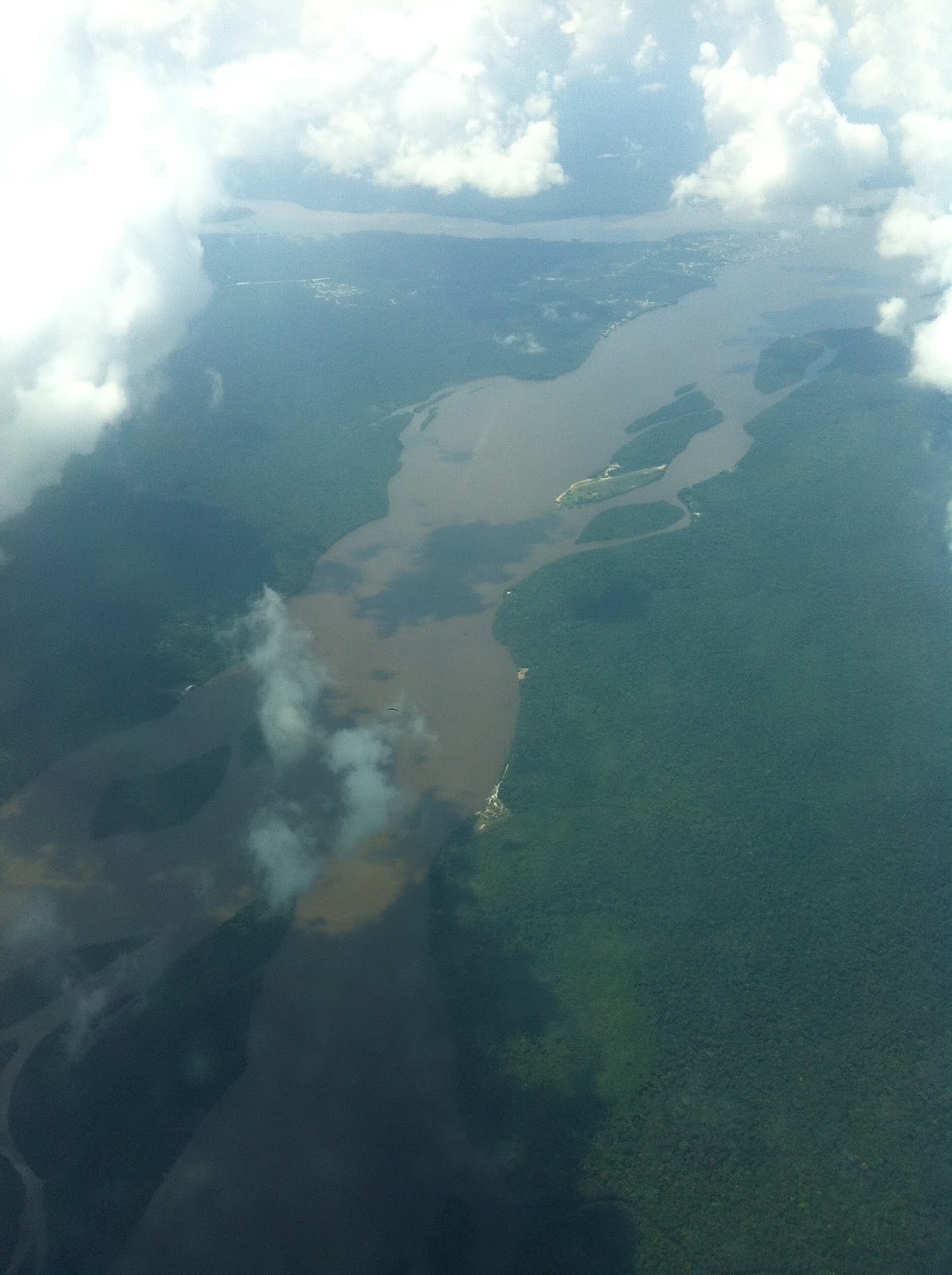
I was treated to a lovely aerial view of Guyana. I watched as the communities gave way to farm fields which then gave way to the vast Amazon rainforest that makes up a big chunk of the country. I was amazed to see how far the endless canopy of treetops extended, like a giant broccoli crown. It helped me realize just how much of Guyana is pristine wilderness - like much of Canada's north - which is one of the things that made me want to come to Guyana in the first place.  This is what I love and where I love to be: in the middle of nature, far from any signs of city life. At least until the mining companies come in.


Aerial view of Georgetown

The Atllantic Ocean is brown

So much forest
And then I fell asleep, which is why prime airplane seats are generally wasted on me.

I woke up when my travel companion nudged me just as we flew over Kaieteur. The landscape was still rainforest, but had changed dramatically, as we were surrounded by chains of mountains and daunting cliffs with brown rivers cutting through them.


The plane touched down on a tiny airstrip in a small opening in the jungle which was, along with a small cabin that had washrooms and a waiting room, the only visible man-made structure that I could see in the area.


Our guide
We were greeted by two Amerindian guides who took us through the rainforest, over and under and through the huge boulders that form the enormous and ancient precambrian Guiana Shield.  Unlike the lady passenger who for some reason decided to wear sandals on this trip, I was thrilled to have a chance to do a bit of hiking, but it made me wish I hadn't gone to Space Gym the previous day to do a hundred squats and lunges. My legs complained, even though it wasn't a particularly challenging hike (unless you wore sandals).


Our guides pointed out various plants along the way. Many of them were carnivorous plants that fed on mosquitos and other insects, which is why we weren't being pestered by them at all during our walk.  I considered stealing some to bring back to my mosquito-ridden apartment. Seriously considered it. Did not, because we aren't supposed to alter the environment while in the national park.  But what an idea.


may not look carnivorous but it is


more carnivorous plants


Parts of our hike took us over cement bars propped over deep crevices and sometimes into them. My guide assured me that there were no jaguars around during the day, and that they were generally shy about people. 


Suddenly the hiking trail spit us out into Johnson's View, the first viewing point of the waterfalls.


I like the fact that the trails and lookout points here do not have guard rails. They do make the heights of the cliffs seem a lot scarier, but as long as you keep a sensible head and don't take risks in stepping too close to the edge, you can enjoy an unspoiled view of the waterfalls, and the river rapids.


After taking a large number of selfies, we then continued through the trail to arrive at the second lookout, slightly closer to the falls, called Boy Scouts View, for the Guyanese Boy Scouts that used to camp here.  Which by the way, sounds like an awesome camping trip. I don't remember much of what I did during my short time in Girl Guides, but I seem to recall sewing buttons.


Finally, a little further down the trail, we arrived at the third lookout point, which our guide called Rainbow View.  Indeed, there was a rainbow arching over the falls. It was so damn magical.


rainbows everywhere


After I had my fill of taking selfies from every angle imaginable, I just stood and admired the view of Kaieteur.  Waterfalls are such magnificent things.  As I had mentioned before, Kaiteur is one of the world's most powerful waterfalls, propelling such a tremendous amount of water down the towering ledge with such a tremendous amount of force. To me, it looked like sorcery to watch the river water break into white streaks resembling dynamic cave stalactites rushing down, as some of the water turns into mist and the rest of the water crashes into the bottom with a spectacular roar. I was mesmerized, and my guide had to remind us that our plane was waiting back at the airstrip.

On the plane ride back, one of the passengers got to ride up front with the pilot. I was mildly jealous, but the reality is I would have slept through it all anyway.


landing the plane


Friday, September 16, 2016

finding water in the best way ever


When I woke up Sunday morning, a palm tree slamming its leaves against my window had knocked down the makeshift window screen I had made out of an extra mosquito net, letting in new hungry hungry mosquitos.

 (what a weird sentence that was. never thought a palm tree would turn against me as a nemesis.)

More pressingly, we were still out of water, which happens occasionally (sometimes mid-shower). Actually, some of the taps were out of water. The other taps were spewing out brown sludge, which made me decide I should skip my Korean skincare beauty routine for that day. Instead I brushed my teeth with coconut water.

(not sure how my dentist will feel about this.)


The lack of water was a pain, because I needed to do laundry and was out of underwear. Also, the internet was slow because everyone was on it. And we had drunk all of our potable water.

No running water, no drinking water, no underwear, no internet. I thought for a moment about escaping to a hotel room for one night, where there would be glorious air conditioning, bathtubs of water, room service and laundry service. But instead, I decided to treat myself by splurging a couple of dollars to get into the Tower Suites pool. Two words: Swim-up bar.

(that might have been three words)


The pool bar was open, there was an endless supply of plaintain chips, as well as an endless supply of Sam Smith, which was what the hotel was playing all day.


Can I just also repeat that one of the things I love about Georgetown is that the four storeys of the hotel makes it a tower?


By the time I got back home, the water and internet was back on, and I could get my laundry done.

(actually my kind landlady did my laundry for me)

 Travel tip: you never know what your laundry situation will be, so be sure to only pack the kind of underwear you want all your neighbours to see, flopping on the clothesline in the wind.