Showing posts with label Inuit. Show all posts

Monday, March 10, 2014

gone fishing

I bought a ceremonial Inuit spear because why not.

come here fishies

Tuesday, March 4, 2014

Art in Nunavut

I wasn't much of an art collector when I lived down south, and even now, I wouldn't consider myself to be very knowledgeable about art. But I do know what I like.

Artists often stop by my office to say hi and show me their newest work. There are a lot of talented artists in town - a disproportionate number of them, I'd say - and now that I have a steady job, I like the idea of supporting the local art scene. These artists' visits give me a fascinating glimpse into the world of Inuit art.  After you've been up north for a while, you start getting a feel for the various artistic styles of the different regions of Nunavut, as well as some insight into what your own personal artistic preferences are.

Wall hangings are pretty popular in Cambridge Bay, felt canvasses with various scenes of northern life sewn on to them.  Personally, though, I love the prints.

"Wishing for Food" by Mabel Nigiyok (Ulukhaktok)

This is the print that is hanging in my office, titled "Wishing For Food". I love it. I love the bright colours, the abstract concepts illustrated so vividly, and the raw emotion that you can actually feel in the wolves.  Also, it's a feeling I know well, when I sit in my office.  I'm hungry a lot.

Printmaking was introduced to the Inuit in the 1950s, using stencils.  Each graphic is reproduced only a limited number of times, which ensures that each print is valuable. Ulukhahtok (also known as Holman) is well known for their beautiful prints. It's the only other community on this island, Victoria Island, and is considered to be part of the Northwest Territories. One day I'd like to go there and visit their printmaking studio.

"Any More Down There" by"Wishing for Food" by Mabel Nigiyok (Ulukhaktok)

Inuit carvings are also a famous art form all over Nunavut.  The Inuit have been carving things pretty much forever, especially to make tools like knives, but carving as an art form was heavily encouraged by the Canadian government in the 1950s.  The Baffin Correctional Centre has a carving program in the prison as a rehabilitative program for prisoners, which interestingly means that some of the best carvers in the area learned/perfected their skill while doing time in prison.  

a handmade ulu, traditional Inuit knife, with the handle made from caribou bone.

The sculptures are not particularly cheap to purchase up here, but they sell for a fortune down south.  Someone once told me that if someone breaks into your house, it's likely that all they will steal is your alcohol and your carvings.  They won't touch your TV, which is bulky to carry.  But carvings are relatively easy to grab and have enormous (and quick sale) cash value .

Drum dancer sculpture, by Jorgan Klengenberg (Cambridge Bay)
The drum is made from baleen, the drum stick is made from muskox bone, and the rest of the sculpture is made of soapstone.

Carvings can be made from all sorts of material, including soapstone and soap stone.  In Cambridge Bay, the stone materials are usually brought in from somewhere else, like Gjoa Haven, because as far as I know, most of the rocks around here are shale, which is fun to collect and take home as sushi platses, but break way too easily to use for sculptures.

My personal preference for carvings are ones that are made from bone.  Especially muskox bone or horn, because muskoxen are pretty much unique to this area.  

Ulu-shaped muskox horn earrings

snow goggles carved out of caribou bone.  
We bought this as art but it's actually quite functional and wearable, 
in terms of blocking your eyes from the glare of the snow

I also really like carvings made out of baleen, which is the "teeth" part of certain whales, like bowhead whales, which is not particularly easy to get.  You know, because you have to first catch a whale.  The carvers usually get their baleen materials from out of town (like Pangnirtung), because I don't think anyone's hunted a bowhead whale in Cambridge Bay in years.

Inukshuk-shaped baleen earrings shaped as inukshuks

knife with baleen blade, caribou bone handle

Cambridge Bay also has some very talented non-Inuit artists. Denise LeBleu is a local photographer who takes lovely photos of the northern landscape, photos which are often featured in the newspaper. Miguel Chenier is a local artist who makes breathtaking landscape oil paintings with brilliant colours that I just can't stop looking at. I guess it's not so surprising that there is so much beautiful art here, for a relatively small town, if you consider the gorgeous Arctic scenery that we have as inspiration.


so, what should we do with this muskox horn we got?


Wednesday, July 10, 2013

Inuit games on Nunavut Day

Yesterday was Nunavut Day, and I was excited to celebrate it. Yes, it was partly because I got the day off work. But I was also looking forward to checking out the traditional games that were being held that day.

Nunavut Day is a territorial holiday that was originally meant to mark the day Nunavut became a legal independent territory on April 1. However, it was changed to July 9 to mark the important Nunavut Land Claims Agreement. On this day in Cambridge Bay, the hamlet hosts traditional activities and games, as well as a free barbecue. Free barbecues!

our mayor opens up the festivities

It was a strange summer day, in that it was both chilly and buggy. Usually it’s one of the other: warm and buggy, or too windy for bugs and therefore chilly. I’ve discovered that the mosquitoes here in the north are Magical Mosquitos, much unlike their southern brothers. Where normally you could spray yourself with DEET products to repel mosquitoes, Magical Mosquitoes laugh at you and consider the spray to be a tasty marinade for your skin. Where normally you could don long sleeve shirts to protect yourself from the bugs, Magical Mosquitoes apparently grow vampire fangs and bite through your clothes. Where normally you could stand by the fire to keep warm and have the smoke keep away the bugs, Magical Mosquitoes fly right through fire to eat you. Where normally you could sit in your yard with an electric fan blowing at you to blow away the bugs (…actually, maybe I am the only one who does this…), Magical Mosquitoes grow hummingbird wings that can fight the fan’s wind. Unlike Koreans, Magical Mosquitoes don’t believe in fan death.

Despite the chill and the flesh-eating insects, everybody was in a good mood and having a great time. Companies were giving out awesome swag, T-shirts, bags, baseball caps. Kids were flying kites all over the yard. For the kids, they also brought back the bouncy castle that they call the happy train.

go fly a kite

A number of traditional games were already underway when I arrived.  There was a contest for elders to do animal calls.  There was tug-of-war for the kids, which I now gather is not a game that only Koreans play at church picnics.  There was a spear throwing competition going on, although not at live animal targets, to my disappointment, but at car tires instead. I am not sure that is traditional, but I suppose it might not be practical to be letting loose a herd of caribou in the middle of the town just for realistic target practice.


pretend the tire is a muxkox


There was also a game of Illupik going on, or what I call Full Contact Jump Rope. I suppose many cultures have their own version of jump rope. The Inuit version involves obtaining an avatuk, a bundle of sealskin that the hunters tie to their harpoons as a float so that the seals they catch will float after they are caught. Inuit jump rope is pretty hard-core, and not just because it involves the use of dead animals. From what I can observe, it seems rather adversarial. It’s like your friends turning the rope aren’t trying to establish a predictable pattern, but are trying to find a way to trip you up and smack sealskin into your shins. Pretty neat stuff to watch.


They announced the beginning of the tea boiling competition.

“Tea boiling competition?” asked I, the woefully ignorant southerner. “How do you compete in boiling tea?” Wild fantasies of Gloria the Excellent Tea Boiler raced across my mind.

“You have to build the fire yourself. It’s whoever can get the fire going and the tea boiling the fastest,” they told me. The visions of Gloria the ETB disappeared, as I began to understand why there were piles of rocks at each station. I would never stand a chance against the elders. After the ready-set-go mark, the Inuk ladies literally ran and built their fire within seconds.


After the Fastest Tea Boiler was declared the winner, we all got to try some of the tea, which was good for me, because I was feeling cold and weak. Probably because I was tired from being Mosquito Meat all day.

“This is delicious. What kind of traditional Inuit tea is this? Crowberry? Cloudberry?” I asked.

“Tetley’s,” they told me.

After the tea boiling competition came the bannock competition. My husband had instructed me to watch carefully so I could bring home the Inuit secret to delicious bannock, but it all happened too fast.

You might think it strange to that people would compete to be the fastest tea boiler or best fastest bannock maker, but if you think about the chilly days out on the land, where your fingers are freezing and you’ve set up your shelter, it really is a useful skill to be able to fix up some sustenance quickly. And I really was impressed at how efficiently folks worked. They gathered their ingredients within seconds, squatted on the dirt ground while mixing their dough, and dumped the dough into the melted lard in the frying pan, heated on top of the rocks.

melting the lard

 
frying the dough

There was one particularly impressive mother/daughter team, dressed in identical traditional parkas, with the little daughter mixing her own bowl of dough. And again, we all got to sample the bannock afterwards.


After the bannock-making competition came my personal favourite activity: the fish filleting competition.

I know, it's kind of weird: I've gone from abstaining from eating seafood for a decade because fish grossed me out, to wanting to get my own fishing rod or even better a fishing spear so I can be a true man of nature and catch (stab) my own dinner.  I wanted to see how the masters did it.


Just look at all that Arctic char 

Again, I wanted to see the competition so I could watch how they properly filleted the fish, but it all happened so fast. These ladies and their ulu meant business; they could cut up and gut a fish with a few smooth strokes in ten seconds flat. You'd miss the whole thing if you blinked.  Arctic char aren't exactly small fish either.


using an ulu (traditional knife for slicing meat)

Everyone was cheering their favourite contestant on.  A family gathered around one elder. "Go Nana! Go Nana!" they chanted.  One lady skillfully pulled a piece out of the fish guts and tossed it to her friend. Her friend laughed and dropped it right in her mouth. "What was that?" I asked her.  "Eggs!" she said gleefully. Others gathered around, asking for the liver or other favourite part of the fish. 


Meanwhile. I'm still not sure I'd be able to tell a fish's brain from its butt.  But this will all change, once I get my own fishing gear one day.

Saturday, February 16, 2013

Fashion show! Inuit throat singing, drumming...and square dancing

 
With the big regional trade show in town, Cambridge Bay has been bustling all week! There isn't a single vacancy, and there have been festivities every night. On the second night, there was a big event happening in the gymnasium, including a fashion show, so I decided to check it out. It wasn’t hard to figure out where everything was happening – it seemed like every car in town was parked at the elementary school.

 The first performance was dancers.  I thought, Man, I am curious to see what traditional Inuit dancing looks like.  Imagine my surprise when the dancers poured into the middle of the gym and began square dancing to country folk songs. Straight up square dancing, about ten dancers varying in age range from very little kids to older adults, weaving and bouncing to fiddle music, complete with Yee-haw's punctuating each line.


swing your partner round and round


When Scottish whalers first met Inuit people in the 1800s, there was a sort of cultural exchange that happened along with the usual material trade. The Inuit taught the whalers some important skills for surviving in the winter, and the whalers taught the Inuit some of their folk songs and the dancing that goes with it.  As a result of these friendly interactions,  stuff like Scottish folk music and square dancing have become an accepted part of Inuit traditions, and people seem to love it.


Then we were treated to performances by the Ikaluktutiak drummers, a group of talented young women who showed off their talents in singing, drumming, and dancing to short songs.  There was an adorable little girl who stole the show, doing every move perfectly, holding a drum almost the same size as her.  There was something truly haunting about the sound of women singing a capella, accompanied only by drums.  One song had beats of four, with each beat to represent the people of the Arctic: Canada, Greenland, Russia, and Alaska.  Another song involved a bird dance, with each lines punctuated by bird-like chirping sounds.  I was impressed by how many songs they knew by memory.


The drummers were followed by two cousins doing throat singing.  Have you ever heard Inuit throat singing? It is honestly one of the most amazing music I have ever heard.  Here is an example of what throat singing sounds like:


 The way that the performers explained it to us, throat singing is sort of a friendly competition held between two women, holding each other closely, with one woman leading and the other following, producing incredible rhythmic sounds from their throats until one of them can't keep up or the other breaks away laughing. Kind of like a staring contest, except throat singing requires remarkable talent and practice, compared to staring. The girls performed songs that imitated different aspects of nature, like the buzzing of mosquitos, or the barking of dogs, or the cawing of birds. The last song was my favourite. It was about a girl singing to her puppy, hoping he grows up to be the leader of his dog pack one day.


 After the two throat singers left the stage, I thought, how could they possibly follow up that act? The answer: A blind Inuk violinist. I am not making this up.


 I've seen Ashley hanging out at the library before. He's always there. The emcee led Ashley up the stage and helped him sit in his chair. Ashley then effortlessly tuned his violin on stage and launched into a fast-paced fiddling tune, the same kind of music that the square dancers had been dancing to earlier. He had the whole audience clapping along.

 Then he put his bow away and began strumming chords on it like a mandolin, humming along. Watch out, Andrew Bird, watch out. This self-taught blind Inuk violinist just might overshadow you.


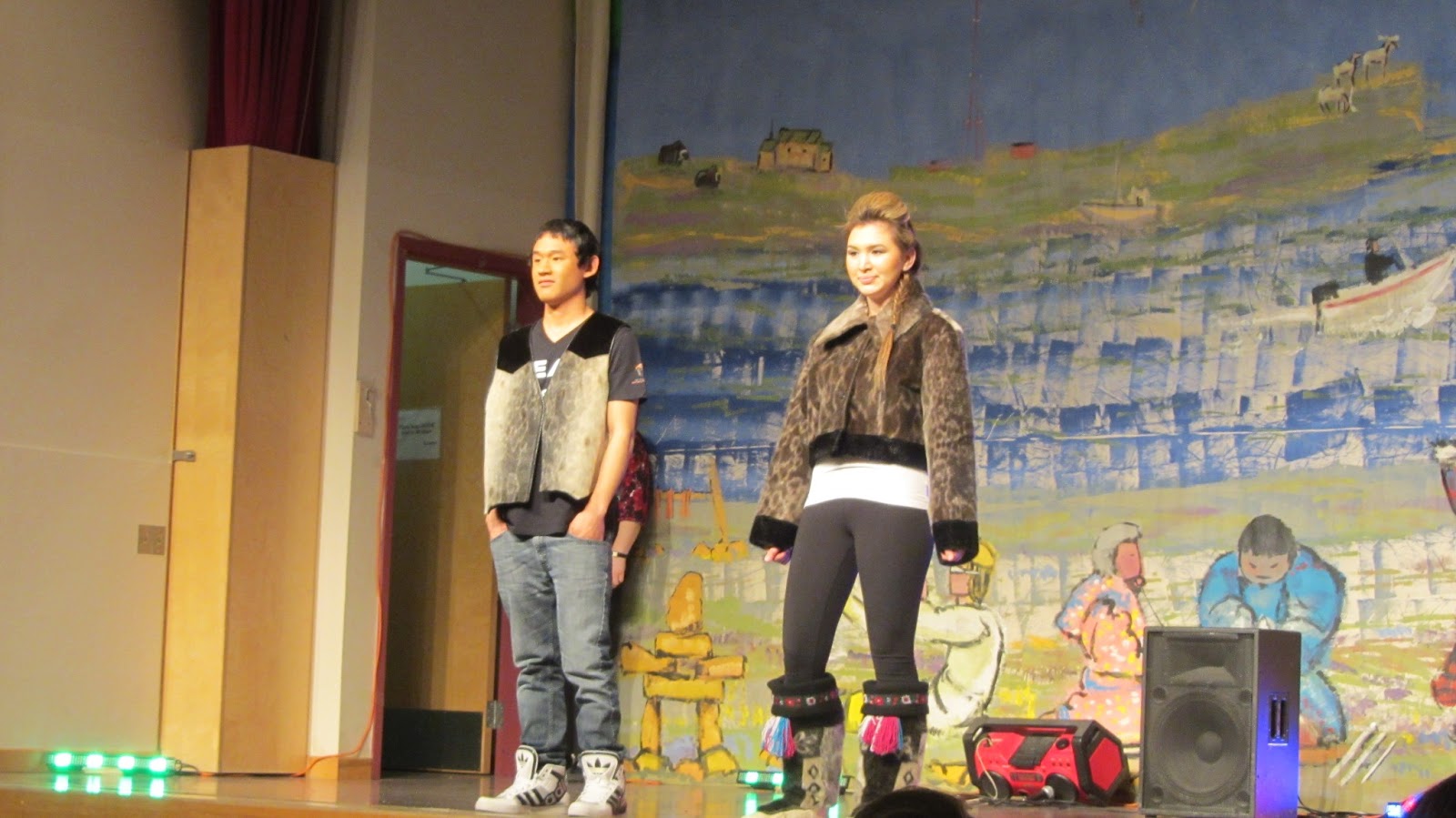
 The final act was the fashion show, presented by the Nunavut Arts and Crafts Association. It wasn't the kind of fashion show you'd see on the runways of Milan, presenting the latest Gucci or whatever name I can drop to make myself seem like I know high fashion. This was a display of the latest fur/leather fashions made by the local designers of Nunavut, beautiful outfits skilfully interweaving modern fashion trends with traditional fur skills that would have made a fashionista weep with joy. It probably also would have made a PETA activist weep too, for different reasons. Especially when the fashion models concluded their presentations by flashing their T-shirts that read: "SEAL IS THE NEW BLACK." I approved.