Showing posts with label asians. Show all posts

Wednesday, January 21, 2015

Pacific Mall

More stories from my holidays - continuing on my Asian immersion experience in Toronto


I took my husband to Pacific Mall, the largest indoor Chinese mall in North America, located in Markham, of course (where else?).  The mall corridors are named after famous Hong Kong streets, and the shops are filled with huge crowds of Chinese people, and tourists who want to look at the huge crowds of Chinese people.

Like China, the mall was crowded and it was nearly impossible to find parking. Eventually after circling around and around, we just illegally parked the car in a spot that arguably could be a parking spot if you didn't look too closely, and we didn't think anyone would look too closely.


Pac Mall used to be really famous because of the way the shops would openly sell very illegal pirated copies of movies, video games and TV shows. Basically, you'd go into the shop, scan the very expansive catalogues, and indicate to the shop clerk what Korean drama you wanted to purchase. The store clerk would take your money, tell you to wait five minutes, disappear and re-emerge with a freshly burned DVD of whatever you wanted. Nowadays, in the age of Netflix, I wondered if the open-air bootleg industry was still thriving at Pacific Mall.

It seemed like despite the rise of the Internet, the pirates were still in business. We still found the "video store", with their stacks and stacks of movie selections, and angry signs that mysteriously read "No!! Sony player".  They weren't as plentiful as they used to be, though.

I am told these photos do not do the grime of Pac Mall justice

We grabbed some bubble tea from an area that seemed to be the Bubble Tea zone and checked out some of the other shops. They sold all sorts of things, but especially cell phone accessories. A few years back, these places were all about the little ornaments you could hang from your cell phones. Now that iPhones have replaced the flip phones, it's now all about iPhone covers and selfie sticks.  Each store had more angry signs that said things like "PLEASE DO NOT TRY OUT THE LIGHTS OR NAIL CLIPPERS". We did not try out the nail clippers.  I spent the majority of my money at the Korean cosmetic stores. We also bought a pair of knock-off Crocs, which to my disappointment were not called "Clocks".


Pacific Mall is a pretty magical place. Terracotta warriors guard the public bathrooms. The oddly familiar looking electronic store "Best Shop" is on the top floor. The food court is just past the "Luck" Bridge, and is like a step into Asia, with the ramen noodle stands, pig's heads and whole ducks hanging in the display cases, and a tattoo shop located right in the middle of the food court. It reminded us of shopping in Bangkok.


Monday, January 19, 2015

Toronto's (north) Korea Town - or, How I Ate For Forty-Eight Hours Straight

More stories from my holidays.

With 3 shootings in Ottawa in the last 48 hours, it was time to leave for peaceful Toronto.

One thing I miss when I am up north in Nunavut is that sense of belonging to my Korean heritage. I am one of the very few Koreans in Nunavut and the only one in the Kitikmeot region. I consider myself to be a multi-faceted person, so being a Korean-Canadian is not the only thing to define me, but it is an important part of my identity, and sometimes it's nice to be back in a place with lots of other fellow Korean-Canadians. Like in Toronto.

We were in Toronto for about 48 hours. We pretty much spent the entire time eating.

Ah, Korean food, how much I missed you. Back at home in Cambridge Bay, sometimes my husband will cook kimchi chigae or I'll fix up some kimbap. In Ottawa, people speak of going to "the Korean restaurant" as though it is a uniform solitary type of cuisine, usually in the form of bulgogi, bibimbap or sushi (which is actually Japanese). But in Toronto, there are so many choices. So many restaurants each with their own specialty. The Myungdong place that specializes in mandu dumplings, kalguksu noodles, and shabu shabu. Buk Chang Dong which is my go to place for soondubu chigae (soft tofu stew). The Ichiban restaurants that is a Korean take on Japanese cuisine. Even the food court at the Galleria supermarket has its treasures.  So no, I didn't go to the new aquarium or the Aga Khan Museum while I was in Toronto. I didn't even step a foot downtown. My entire trip to Toronto was spent in North York, mostly around Yonge and Sheppard, amongst my peeps eating and drinking,and I have no regrets, although I do have a few extra pounds.

My trip of glorious gluttony started off at our relatives' home, where they had ordered Korean food to be catered to the house.  Lots of seafood. Make no mistake. We ate a lot at this dinner.


what are you looking at

Then as the older generation sensibly got ready for bed, us youngsters headed for the Yonge and Finch area (which I affectionately like to refer to as "North Korea Town", to distinguish it from the other Korea town, down at Bloor and Christie), to eat some more.


First we stopped off at my cousin's condo, where we took a break from dinner by eating more snacks and having a few relaxing drinks. Then we headed out to try out the soju bangs.

Korean-style drinking is a wonderful cultural experience that must be tried. For one thing, the accompaniment of food with your drink (anju) is essential and many Korean bars will serve for an assortment of dishes to go with your drink for free, somewhat similar to the concept of the Spanish tapas. I am of the strong opinion that this is a practice that North American establishments should adopt. Waistlines may bulge, but it also stops you from getting ridiculously wasted.

What do you drink? Soju, of course. Poured for you by someone else, preferably your host or someone younger than you, with both of yours hands holding the receiving glass. With a toast, possibly as part of a drinking game that involves a lot of singing. Chased down with cheap beer. It could be Molson; doesn't have to be a fine beer, because beer is just what you drink between your sips of soju.

one of the brands of soju. This name means "like the first time". Koreans love to be nostalgic about innocence.

The first place we  hit up was The Fry, which despite its very English sounding name, was a very Korean soju bar. This place is known for having one of the best Korean fried chicken in Toronto, so of course we had to order a couple of giant platter of chicken to go with our drinks. Plus more anju, in the form of corn, chips, salad, and other random snacks.

We were eating at the Fry to kill time until a table was ready at the joint next door, Han Ba Tang. The manager knew our crowd and visited us at the Fry to assure us that a table was being prepared and that he was asking his kitchen staff to stay extra late especially for us so we can try his food. Which was a good thing, because by the time we got into Han Ba Tang, it was half past midnight...but we still had room in our tummies to eat more.

Han Ba Tang, which aptly means "One More Round" 


So of course we ate some more. Han Ba Tang is known for its clever modern twists on traditional Korean dishes, like kimchi fries and kalbi tacos. But this is no Asian fusion joint with notions of the exotic served by waiters who don't speak Korean - other than our table, most of the patrons at the bar were fresh-off-the-boat Koreans.

Kimchi fries, topped with bulgogi


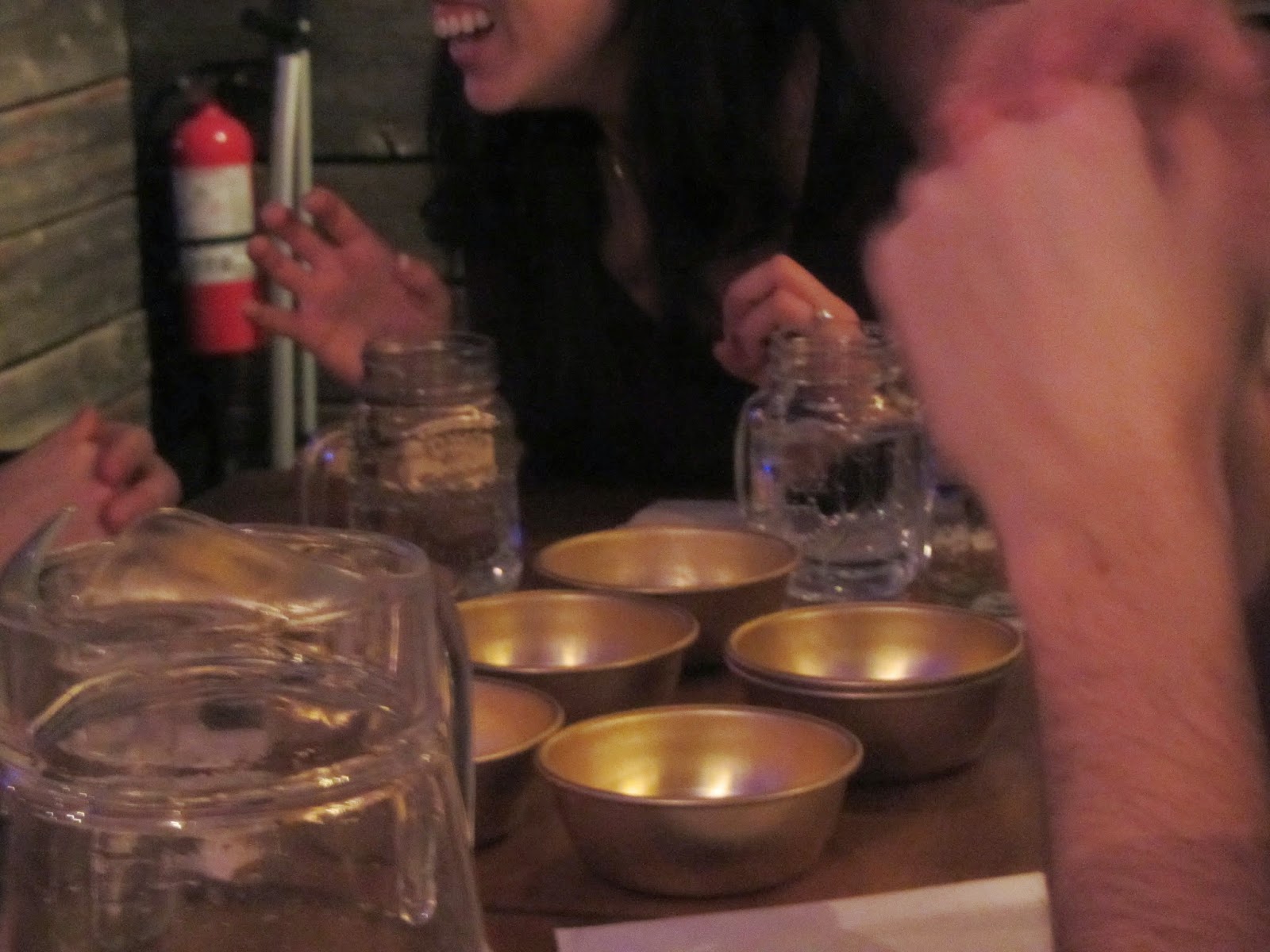
Makgoli, another type of Korean liquor, traditionally drunk out of wooden bowls

Seafood stew with ramen noodles, which are apparently the perfect midnight snack


And then by 2AM it was time to head out...and move on to a noraebang, Korean karaoke, where we continued to consume.

Korean karaoke is an essential part of a night out


Wednesday, August 7, 2013

the most epic journey for Chinese food delivery

What do you do when you're craving Chinese food takeout...but you live in a remote Arctic community where the only Chinese guy you know is often asking you for cooking tips?*

*nobody should ever ask me for cooking tips.

Well, you make it happen. You live in the North, so you learn to survive. You make it happen by ordering it from the closest Chinese restaurant, no matter how far that ends up being.

this is how far my Chinese food travelled to get to my mouth

It turned out that the closest Chinese restaurant was in Yellowknife in the Northwest Territories. Yup, 853 kilometes (530 miles) and in another territory.   I mean, when you live in Ottawa, Ontario, you'll drive to a gas station in Quebec so you can buy beer on a holiday, so crossing provincial borders to please the tummy is not unheard of. And yes, one time I rode twenty kilometres on my bike in the rain with another girl on my back because her bike had broken, just to get to the only Korean restaurant in all of Amsterdam. But this was a new precedent in my quest for Asian food.

Chinese food menu

We ordered our Chinese Food from the Gold Range Bistro, a name that does not have any hint of Chinese-ness to it, unless you are alert to the Chinese fondness towards things that are gold. But to be fair, we're talking about Yellowknife - at some point, everyone was really into gold.

(For me though, "Gold Range" invokes a telescoped combination of my two favourite Pavement songs off the Crooked Rain, Crooked Rain album, "Gold Soundz" and "Range Life")


gold soundz

range life

The ordering part was just like any other Chinese food order. On the phone, we picked the items that we wanted off the menu, and then, because I am Asian, I ordered my favourite dishes off the menu.  The restaurant did indeed have my special requests, which was a good sign, because every self-respecting Chinese restaurant knows that Asians love ordering off the menu.

But then, instead of packing the delivery into a Honda Civic and driving it to our door, they sent our order to the airport. And then flew it on a plane.  And then we picked it up at the airport.  And then heated it up again in the oven, because our food had just travelled the equivalent distance of Toronto to the state of Virginia.


Toronto to the state of Virginia
A FEAST! A VERITABLE CHINESE BANQUET! 

Afterwards, in my state of feeling satisfied and full (at least for the next half an hour), I reflected on what a glorious age we live in, that I can call up a Chinese restaurant in another territory and have them delivery beef with black bean sauce to me by airplane.  To be fair, when you live in a remote place, you get used to pulling stunts like this.  My friends have driven the eighteen hours from Cape Town, South Africa to Windhoek, Namibia in order to bring home a bag of Big Macs (Namibia does not have a McDonalds). It's quite normal for folks to grab a big box of Tim Horton's donuts to bring on the plane from Yellowknife to Cambridge Bay. And now, for only a $50 shipping fee, I can get Chinese fried squid brought to my door.*  The whole concept may make a younger "Eat Local" Gloria disapprove, but it's great to know my options.


*but someone needs to pick it up from the airport first.

Monday, March 11, 2013

Asian food in the Arctic


Even though Wikipedia takes the time to point out specifically that there are no Koreans in Iqaluit there are, contrary to what you might believe, Asians in the north. Most famously, there's Sandy Lee, who was the first Korean-Canadian to be elected to a legislature when she served as an MLA in Yellowknife. I also heard a rumour that there's a "Chinatown" in one of the northern communities here, named after the one Chinese family living in that particular neighbourhood. Perhaps Cambridge Bay will now have a Koreatown out in the east end.


Sometime I will write about what it's like being Asian in the Arctic, much like the way I wrote about being Asian in Namibia. Somewhat like post-apartheid Africa, there are subtle politics about me looking like the above photo when you're in a place where there is a noticeable class division that often runs along racial lines. But that will be another time. Today I'll answer an important related question: How do you get Asian food in the Arctic?

I've already written about food politics in Nunavut in terms of pricing, but seeing the range of what is available is also interesting. Cambridge Bay does not have a local Chinese food takeout restaurant run by an endearing Chinese family. The local grocery stores do however have an surprisingly adequate supply of some of the basics that you can cook on your own: spring rolls, thai curry sauce, soya sauce, ginger. Notably, however, neither grocery store carries sesame oil, a key ingredient in Korean cooking, which makes me glad that we brought up our own supply of sesame oil.


and, pretty much every other key ingredient in Korean cooking.


So in short, you gotta make your own. We've been having fun experimenting with different fusions of my heritage and local cuisine. For example, muskox ma po tofu:


Ma po tofu is one of my favourite Chinese dishes, and substituting the ground meat for ground muskox was easy, delicious, and possibly even healthier, given the fact the muskox meat is much leaner than beef or pork.

We also have been having fun with Arctic char sushi maki rolls.


okay, so I might have to work on presentation a bit more

Arctic char is a yummy delicacy that trendy restaurants in, say, Manhattan, will pay top dollar for. If you see Arctic char on the meny at your local fancy restaurant, chances are it came from the meat plant here in Cambridge Bay. For these sushi rolls I used Arctic char jerky, which gave it a distinctive salty taste. I'm going to try raw char next time, maybe soaked in a little vodka, if I can ever get my hands on vodka.

But hold on, you say. How do you get a steady supply of the most important dish in Korean cuisine? That is, of course, kimchi. It's not like you can find nappa cabbage growing around these parts, right? And unfortunately, we didn't have a chance to get the family recipe for kimchi-making from my grandmother before we moved up north. The answer? Canned kimchi.


Yes, canned kimchi really does exist, and you can buy it from Asian grocery stores in Toronto, and ship them up. It doesn't taste anything like my grandmother's stuff, but it'll do. As an extra bonus, the cans come with nutritional info which just goes to show how awesome kimchi is. A source of vitamin A, C, calcium and iron, and if you eat the entire can (if your mouth is strong enough to take the heat), it's still only 10 calories. I love kimchi.

And of course, we can pack our leftovers in our Korean specialty Glasslock tupperware container.

Sunday, January 22, 2012

on being asian in namibia

새해 복 많이 받으세요! Happy Lunar New Year!

When I moved to Africa, I brought with me one pack of 맛있는 ramen (literally, delicious brand) and one pack of Chappaghetti, an instant noodle version of my favourite Korean dish 자장면. I figured that Korean comfort food might not be readily available in Namibia, so my plan was to eat the Chappaghetti as a treat on Christmas and the ramen on my birthday. As it turned out, I was in Cape Town over the holidays so I got to eat real Korean food – kimchi chigae – so I decided to save my Korean instant noodles until I had a bad day, like if I got robbed or something

(and so now the Chappaghetti has been consumed...)

“Per capita, South Koreans consume the greatest amount of instant noodles.”
-Wikipedia

Being Korean in Namibia is a very unique experience, although not a lot of people realize that my experiences are sometimes different from theirs. I don’t, for example, share my foreigner friends’ concerns about being mistaken for an Afrikaner or a German Namibian. When I walk the streets alone, I get a very different form of street harassment than my girl friends do, although nobody ever knows about it because it only happens when I’m alone. When I first arrived in Namibia, I wrote a little about my impressions of being Asian in Namibia. Now that I’ve been here for a bit longer, I can expand on this a bit further. It seems particularly suitable to do it now that today is the Lunar New Year, one of the biggest holidays to celebrate in many Asian countries.

are you the only Korean in Namibia?
Sometimes I feel like I am. I am being told, however, that I am not. I have been told that there are some North Korean workers here, and one woman named Jin-Seng who sells kimchi. I have been given her number, but I am too shy to call her up, even at the worst of my kimchi cravings.

then how do you get your kimch fix?
There is a small shop in the Hidas centre run by a young Taiwanese couple. The kimchi is at best okay. It’s not made with the proper nappa cabbage and it’s nothing close to what my grandmother makes. But it’s better than nothing...sometimes. Sometimes nothing is actually better.

Who are the other Asians in Namibia?
I read this great book over the holidays called “A Matter of Honour: Being Chinese in South Africa” written by Yoon Jung Park (who is Korean). It follows the history of Chinese people in South Africa, from the indentured workers and shopowners who arrived centuries ago, to the Chinese communities dealing with apartheid laws only two decades ago. There actually is a significant Chinese population in South Africa that has been here for several generations, and many of these people consider themselves to be Chinese-South African, or sometimes more South African than Chinese.

Namibia does not seem to have a similar Chinese community that has been here for many generations. However, China in general has a large business presence in Africa, so there are actually a lot more Chinese labourers and businessmen in Namibia than you’d expect. Most of them are straight from China, and they seem to generally stick to themselves. This is probably why Namibians assume I am Chinese, and why they are so surprised that I speak English.

My understanding is that there used to be quite a few Malaysian factory workers here, although I don't know if they're still around.

I met two friendly young Asian-Americans working for the American embassy here, named Anna and Steve. They are the only second generation Asians I have met here. They were the ones who told me about the existence of the kimchi-seller in Namibia.

how do Namibian men behave towards young Asian women?
I think straight Namibian men have a secret game that they play that is similar to our game Punchbuggy. In Punchbuggy, every time you see a yellow VW car, you have to punch your friend while yelling “Punchbuggy!” In this game that Namibian men play, every time you see a young Asian woman, you have to yell “CHINA!” at them, possibly punctuated by offensive ape-like sounds that you think imitates the Chinese language.

It’s either a game where you score points, or it’s a bizarre medical condition similar to Tourette’s Syndrome where the sight of a young Asian woman shuts off an otherwise perfectly normal Namibian man’s brain, and produces ticks that involuntarily force to exclaim “China!” and a series of socially inappropriate words.

Sometimes it does seem like an involuntary tick. Once when a security guard did it to me, I turned around and demanded to him, “What did you just call me?” and he had the most surprised look on his face, as though he too was surprised at the words that came out of his mouth. Although he might have just been surprised that I spoke English.

What complicates things is that Afrikaners will sometimes use the word “My China” to mean “my friend”.

This has resulted in me having no motivation to ever do my hair, wear makeup, or wear properly fitting gender-appropriate clothes. If I can have Namibian men yell at me that they want to marry me because I am beautiful, when I am slumping around town in a men’s baseball cap, yesterday’s ponytail, thick glasses and my dad’s swimming drunks, I have no reason to ever try to look decent.

How do the other Namibians behave?
Creepy male strangers on the street aside, I have found most of the Namibians I’ve met and hung out with to be enlightened, polite, and respectful to me. When they ask where I am from, I say “Canada”, and they accept that as an answer, rather than pester me to reveal where I’m really, really from like the way some white Canadians do to me back at home. They don’t generally address my race unless I bring it up first, which is how I like it. This may be because the Namibians that I meet are the ones who are used to making friends with tourists and foreigners. It may also be because I have awesome Namibian friends.

Some Namibian women have asked me to give them my hair when I leave Namibia, because they really like my hair and would like to turn them into extensions. I find this to be quite flattering.

where can you buy asian groceries?
I mainly get my Asian ingredients from the Taiwanese store. There is a “Chinatown” in the Northern Industrial District, but it’s rather far and out of the way, and I haven’t had a chance to go yet.

I have also found out how to buy tofu in Namibia. Basically I go through the Taiwanese couple, placing an order beforehand. The tofu orders come once a week, on Mondays, and I have to rush there after work in order to get my pre-ordered week's supply of tofu before the store closes. It's kind of hardcore. I've started ordering tofu for my friends too, because it's such a pain-in-the-butt process, and have become somewhat of a tofu dealer in Windhoek.

where can you eat asian food?
There are two Chinese restaurants that I know of in Windhoek. One is the Yang Tze Village in Klein Windhoek. My Namibian friends tell me that the Chinese gang members meet in the private rooms here on Sunday evenings. My white friends don’t like the food here, but this may be because they are ordering from the menu, which I never do. I find that if you have a simple craving for Chinese take-out, this place can hit the spot. One of the owners is a Chinese-Canadian from Vancouver, and I have somehow gotten on a first name basis with their daughter, who likes to talk about how much she wants to go back to Vancouver, and how she can’t believe that I’d voluntarily move to Namibia out of my own free will. She lets me order off the menu.

The other Chinese restaurant is a fancier looking one called Chez Wou at the country club. I know. When you think “Chinese restaurant”, you don’t usually think “country club” or anything starting with “Chez”. But it makes sense here. With all the Chinese businessmen investing in building projects around the country, I guess they want a nice place to have meetings and entertain their guests, and what better place than a Chinese restaurant at a country club? This may also explain why there is a casino here as well. I like this place a lot too, and would probably eat here more often if it wasn't so far away at the country club and so dangerously close to a casino.

There are rumours of an Indian restaurant somewhere in Windhoek. Nobody knows where it is. I suspect it has been shut down.

do you feel more Asian in Namibia?
Yes. Partly because of how strangers perceive me, but also the acute lack of my parents’ Korean food every night. Also, although many Namibians seem to view me as being white, I often experience feeling like I have a different identity from my white friends in terms of certain attitudes (and, dare I joke, dance moves?). This is somewhat unusual because in Ottawa, I don’t have a terribly strong sense of being Korean. Moving here, however, has amplified it quite a bit. Post-apartheid Namibia is one big identity crisis for all of us.

I did, however, have one interesting race-related experience with a taxi driver.

cab driver: "I want to meet a nice coloured girl. What tribe are you from?"

me: "er...tribe of Canada?"

cab driver, miraculously still not clueing in that I'm not part black: "Oh, I see. I've been looking to marry a coloured girl, you see. Are you married?"

me: "Yes, I am married." (Awkward pause) "Why do you want to marry a coloured girl? Do you find them to be pretty?"

cab driver: "Well, you see, I drive this taxi all day so I have back problems. So I'm can't really please a woman."

me: "I understand." (I didn't actually understand) "Well, I think this is my stop, I'm going to go now." Gloria steps into traffic.

This was the first time, but oddly enough not the only time, that I was mistaken for a coloured girl (part black, part white) in Namibia. It felt almost refreshing to be noticed for once as a coloured girl, rather than as a China.

Got more questions on the topic? Ask me! Maybe I'll answer. Or maybe I won't. Chances are I might not, since my laptop was stolen. But ask away anyway!

Thursday, September 22, 2011

black and white and YELLOW

A few thoughts on race issues, and being an Asian woman in Windhoek.

After apartheid, officially sanctioned racial segregation was no longer imposed, but you still see quite a divide drawn along racial lines. The townships of small modest sometimes rundown houses are still full of black and coloured people, whereas the affluent neighbourhoods with barbed wire fences, electric gates, guard houses, and palatial structures are mostly white people. What I find very interesting, and sometimes annoying, is the way that I am considered to be “white” here, because of my relative position of privilege. As a foreigner, I’m perceived to be a tourist here, and therefore rich. My closest friends that I’ve made here are white, and I live in one of those affluent white neighbourhoods. At nice restaurants, the service staff treat us extra politely and the chef sends us complimentary dishes from the kitchen, I guess because people assume we are important (HA HA HA). People have even offhandedly referred to me as being white, and I can’t deny the feeling of not being “one of us” from the men who catcall me in the streets.

Here’s the thing, though. I’m not white. Back in Canada, nobody ever treats me like I’m white – in fact I am constantly reminded of my Asian identity back home. I eat Korean food at home with my Korean parents every night. My grandmothers speak to me in Korean. I still hold on to some Korean etiquette even in Canadian settings – feeling uncomfortable and horrified, for example, when French Canadians try to greet me with a kiss (why can’t we just bow respectfully from a safe distance?), or when my friend’s mother asks me to call her by her first name.

More importantly, I am still sometimes discriminated against because of the fact that I am not white, but a woman of Korean ethnicity. Canadian men who sexually harass me on the streets, for example, say very specific things to me that they do not say to white women. As much as I embrace Western culture and values, and have many friends of many ethnic origins, I do not identify as being white, nor do I have any particular desire to be identified as such. So to be classified as white here in Namibia is a bit of a jolt to me and my identity at times. I mean, I understand it – clearly I’m a person of privilege and I’m not black – but my feelings towards this alternates between amusement and annoyance.

The status of being Asian in Namibia is pretty interesting on its own. The other Asian worker I met here told me that she has travelled all over the country, and from what she’s seen, it is quite probable that I am the only Korean person in this whole country. Which means I probably won’t find someone else to make me kimchi chigae, sadly. When I asked a Chinese girl who had visited Namibia how ordinary folks viewed Asians, she told me perhaps jokingly that folks here believe that all Asians know kung fu, so they’ll leave you alone. There are other Asian people here, mostly Chinese businessmen, which probably only contributes to Namibian’s perceptions of me being rich. Trust me, though, I am not a Chinese businessman.

My personal experience has been that some of the locals view me to be an unusual creature. I guess it is still quite rare to see young Asian women in some parts here, so a few men can’t resist but try to talk to me, or at least yell “China” at me (an exclamation that I don’t quite understand). As I was told by another female intern, most of this street attention is not terribly derogatory, and it's almost never hostile, unlike in Canada, where sadly some men yell at me shocking things that i am sure they would never say in front of their mothers (sidenote: this is a great website about street harrassment in ottawa). Here in Windhoek, it's mostly along the lines of “Sister I must tell you: you are beautiful”. I feel like these folks mean no harm and are just curious, which is much better than whatever is motivating those jerks back at home. Either way, I suppose it could be worse. There are worse stereotypes than assuming that I am beautiful, exotic, rich, and know kung fu.