Showing posts with label khomasdal. Show all posts

Tuesday, March 20, 2012

sundowner at rivers crossing, sunrising in khomasdal

I'd always heard that Rivers Crossing was a beautiful spot for a sundowner, but hadn't had a chance to check it out because the lodge is about five kilometres out of Windhoek and you need a car to get there - a nice sturdy one too, to make it over the rocky gravel roads.

Luckily, on one of my last nights in Windhoek, AN and S invited me to go for a sundowner with them. They have a nice study car. A station wagon, inf act, which fascinates Namibians everywhere, as they keep offering to buy it off S. They don't really have stations wagons here. I like AN and S because they let me intrude on their cool dates.

I love sundowners. It's a tradition I'd like to bring back to Ottawa. Basically you get to a high spot, and then you have a drink as you watch the sun go down. This may be a bit difficult in Otttawa, which is very flat and has no tall mountains.


We were seated at a table outside next to a swimming pool. I'm pretty sure this pool has the best view that any swimming pool in the world has. It was eerily silent on the top of the mountain at Rivers Crossing, with everything calm and still except for the wind blowing in our faces. It was chilly. AN and I had forgotten our sweaters, so the waiter gave us towels to wrap ourselves up from the cold. I couldn't tell whether we looked extremely cool, like the babes on Baywatch, or extremely dorky, wearing towels at a posh place.

The sunset was absolutely breathtaking. What is it about sunrise and sunsets that fascinate humans so much? Is it part of our fixation on changes in nature, like equinoxes and solstices, watching day turn into night and then back to day? Or does the sunset signify a socially acceptable time to start drinking without being judged as a boozer?


Whatever it is, the sunset at Rivers Crossing was pretty great. It's the rainy season in Windhoek so there were enough clouds in the sky, reflecting pink streaks from the sunset. It was an incredible sight: on one side of the horizon was the setting sun. On the other side of the horizon facing the sunset was a double rainbow.

(OMG WHAT DOES IT MEAN)


You could see the sprawling city of Windhoek in the distance, streetlights on and blinking. It was a very romantic moment for S and AN. And me, the third.

After the dark settled in, I had a very different night in Khomasdal, my new neighbourhood. I went out with nenad, WK, and Wi11be to Wells', a neighbourhood bar in Khomasdal, and incidentally, the first bar I had ever been taken to when I first arrived in Windhoek. As usual, the sight of an Asian woman in a coloured bar drew some attention from the locals, which produced the following conversation

man: Nee hau.
me: What?
man: Nee hau.
me: Why are you meowing at me like a cat? Woof woof.

This is my #1 most common conversation with Namibian strangers. #2 is the following:

man: So are you from China?
me: No, I'm from Canada.
man: Oh, you must take me to Canada.
me: Why do you want to go to Canad? It's very cold in Canada
man: It can be cold in Namibia too! Sometimes it gets down to 10 degrees.
(gloria suddenly starts laughing like a hyena)

Nevertheless, I have great conversations. We stayed out for a couple of drinks, and then hitched a ride home with ZK's old friend from high school, which, as I found out, was actually only last year. It was a bit odd getting teenagers to drive me home - I feel like the natural order of life should make it the other way around. At any rate, we rode home in the back of his pickup truck, which looks like a really cool thing to do but is actually quite uncomfortable. And then everyone stayed up for more drinks and conversation until the sun rose.

Friday, March 16, 2012

my morning commute

on my last day of work, I think it is fitting to describe the morning commutes to work in Windhoek.

In Klein Windhoek, which was where the white people historically had lived and therefore is located quite close to downtown, I only have a few kilometres to go to work, so usually I walk to work. I may or may not have become notorious all over town because of this, because no white person walks to work, and generally you only see black labourers walking on the side of the road. There are no sidewalks generally, so I usually make my way down the dirt shoulders, grass as high as my thighs, past snarling dogs locked behind high gates. I pass the same black labourers every day, and by now we greet each other with a friendly smile and "Goeie môre!" as if we are old friends. I think I also pass the same cars every day, because once in while, maybe at a bar or a restaurant, I'll have the following conversation with a random stranger:

Stranger: "Every morning I pass by this Chinese girl who is walking on the side of the road."

Me: "Oh, that's me."

Stranger: "Really? I'll honk next time I pass you."

Me: "Why don't you just give me a ride??"

I've since moved out of my flat in Klein Windhoek and am now living with my friend Nenad in Khomasdal, the township where they relocated all the coloured people during the apartheid regime. Incidentally, if we were still living under South African apartheid, I think Khomasdal is probably where I, as an "Asiatic", would have been forced to live. I find this to be a very interesting thought.

Commuting to work from Khomsdal is different. The townships are very far from downtown, which was a deliberate decision by the white apartheid authorities, and is a big pain in the butt for basically every worker in the township who has to get to work in the town every morning. Windhoek doesn't have public transportation, not really. I mean, I see these big buses that go around sometimes, but nobody except some of the workers seem to figure out how they work. I suppose you might consider the fifteen or so people crammed in the back of a pickup truck to cound as public transportation, or maybe at least carpooling. But for most people, the main commute to work involves taking a shared taxi.

Taking a public taxi in Namibia is an art form that takes a lot of practice. In Canada, you would hail a cab, jump in, tell him where to take you, and watch nervously as the meter goes up and up and up.

In Namibia, you hail a cab, tell him through the window where you want to go, and then if he chooses to take you, you get in and hope nervously that he won't rob you. At the same time, you try to avoid the stray dogs on the street. On the bright side, any cab ride will only cost you one or two Canadian dollars. On the downside, you have to figure out how to tell him where to take you. Cab drivers (or Namibians in general) don't do street names, directions, or anything that North Americans are used to using to get places. Instead, you have to pick a nearby landmark, a landmark that cab drivers will recognize. I have learned that if I went to direct a cab to my work, they will not recognize "the National Library" which is next door, but they do for some reason know where Kenya House is, which is this abandoned falling apart building that nobody uses anymore which is apparently under construction and has been under construction since God knows when. I have no idea why cab drivers know this.

Also, you can't just hop in the cab and say "Good morning, sir, I'd like to go to the National Library." That's too many words and for some reason they have trouble understand North American accents. Instead, you have to drop your voice very deep, almost to a growl, and bark "Kenya House, nee?" If the cab driver grunts "Unh" he'll take you. If he says "Ah", he won't. Those two grunts sound very similar so you have to train your ear to hear for it. Otherwise you might reach for the car door to get in, only to have him drive off with half your leg in the car.

White Namibians never take shared taxis, which they refer to as "black taxis". They have their own cars. To their credit, they often offer me rides when they see me walking on the side of the road or trying to hail a "black" taxi. Or they'll just honk, because they recognize me.

On another note, HAPPY BIRTHDAY, WILL. Will is the brilliant artist who draws cartoons for me, including the logo for this blog. Everyone say happy birthday to Will.

Tuesday, December 13, 2011

church in the khomasdal township

one of my most interesting colleagues is a South African born woman named L. During the week, she works as a lawyer at my office. On weekends, she's a pastor. In her spare time (whatever spare time she has), she's a doctorate student. She's also blind, so she does all of this - reading legal documents, writing sermons, studying textbooks - without sight at all. And she's brilliant. There's just something about a blind African pastor/lawyer/student that seems straight out of a Coen Brothers movie.

I asked her if it would be okay if I could come with her to church last Sunday, because I've been really interested in the local churches, especially since Namibia is such a predominantly Christian country. She preaches at a Methodist church way out in the township of Khomasdal, which was where the "coloured" people lived during apartheid, and still do predominantly. I haven't been back to Khomasdal since my first night clubbing there, so i figured that visiting the neighbourhood on a quiet Sunday morning for church might be a bit different than the night club.


it was a nice church, a simple building with a cosy sanctuary and a small but very friendly congregation which was mostly composed of older motherly women. It kind of reminded me of the Korean church that my parents helped start up back home, where everything was do-it-yourself and grassroots. There is no dazzling sound-and-light show, no Christian rock band leading the worship with a full PA system. Instead everybody lends a hand in running the service. Hymns are sung with voices only, and from memory without hymn books. It was less about putting on a show and more about joining together as a community, which is what I think churches should be about anyway.


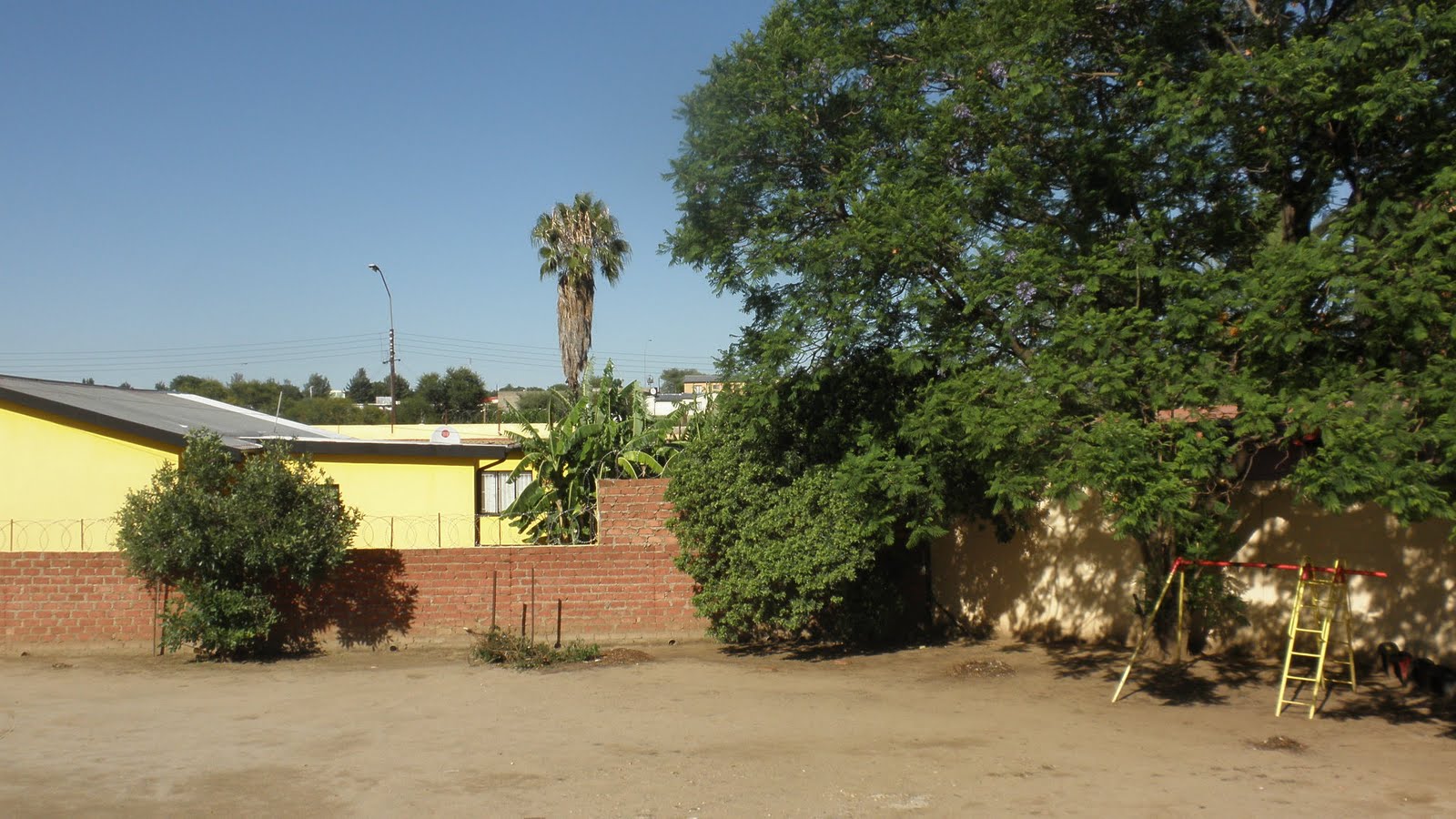
the churchyard


Because the congregation was mostly "coloured", many of the hymns were sung in Afrikaans, but I found myself surprisingly able to follow along anyway. Even though there wasn't a choir to lead the music, I was amazed at how lovely the congregation's voices sounded in the acoustic space, filling in the harmonies naturally. It was one of the most beautiful sounds I've ever heard. And such a wonderful atmosphere of love and community. Nothing fancy or pretension, just sincerity and devotion, just like the way churches should be.